

The History of


Mac Bethad mac Findláich,
King of Scotland (c. 1005-1057)
The House of Moray was comprised of Ruari, the Earl of Moray and his two sons, Maelbrigde and his younger brother Findláich (Finlay).
Maelbrigde had two sons, Malcolm and Gillacomgain.
Mac Bethad mac Findláich, (Macbeth), was born in central Alba around 1005 to his father Finlay MacRuari, Mormaer (high steward or Earl) of Moray, and his mother Donada, the second daughter of Malcolm II who was King of Scotland from 1005-1034.
Early Life
At the age of 7, Macbeth was sent to a Christian monastery to be educated by monks—a requirement for all important chieftains' sons. There he learned the skills of a warrior; speed and dexterity with spear and sword, bow and shield, control and poise on a horse, developing muscle and stamina. He learned that he was a privileged person, that the farmer and laborer worked to feed him and his family and that he owed them protection and help in times of need.
Macbeth was taught history, statecraft, the local customs (of which there were many) and the royal pronouncements and laws that he would be required to administer. He also learned poetry, music, games such as draughts and the ability to drink prodigiously as most young men did.
Returning to his father’s home as a young man, Macbeth was given his first ‘job’ as thane of Cromarty, an estate of 500 acres where he was to manage its administration, ensuring that justice was done for its people and leading the able-bodied men in times of war. This was to put his training to the test and continue his education.
Macbeth’s father Finlay had not distinguished himself well over the years and although he was the obvious heir to Malcolm II under Tanistry law, it is likely that Malcolm II proposed primogeniture to some of his earls, the descent from father to eldest son, to ensure a strong king was on the throne. As Malcolm II had no sons, his proposition was that his first grandson Duncan should follow him on the throne.
Murder
Following Tanistry laws, Finlay’s older brother Maelbrigde would have been the next heir after Malcolm II, and it is not clear how or when Maelbrigde died. It is possible that Finlay did away with Maelbrigde to gain succession to the throne.
It could be that the sons of Maelbrigde, Malcolm and Gillacomgain, understood the mediocrity of Finlay and resolved to take this matter into their own hands by murdering Finlay or it could be a retaliatory event for the death of their father, these circumstances are unknown. Sadly, this was the beginning of a blood feud within the House of Moray. Murder had become a political tool. Macbeth fled to Ireland in exile where he lived for several years. He was 20 years old.
In Moray, Malcolm, aided by this brother Gillacomgain, assumed his uncle Finlay’s position and then crowned himself king of the north. Understandably, this incensed King Malcolm II.
Another contender for Malcolm II’s throne was a young man named Maelbaethe. He was the heir through a senior line of decent from Malcolm I. Like Malcolm of Moray, his claim to the throne would be ignored by Malcolm II in favour of Duncan. Malcolm II planned the eventual transfer of power to Duncan through the ‘removal’ of all those with well-founded rights. Given this, Malcolm of Moray and Maelbaethe formed an alliance, with Maelbaethe’s sister Gruoch given in marriage to Gillacomgain. They soon had a son Lulach, cementing the relationship between the two families. They became known as the Northern Alliance.
Fortunately for Malcolm II, Malcolm of Moray died in 1029. There is no record of any violence associated with his death but there is no doubt that the alliance’s plans were weakened but still the competitors for Duncan’s throne had not been dealt with.
In 1030 Macbeth laid plans to return to Alba. To do so required contacts, and messages were sent to families who had serious doubts about Gillacomgain’s leadership qualities. Macbeth returned to Moray by boat, having sent forces over the plains of Moray to meet him near Gillacomgain’s hall. Surrounding the hall with piles of firewood and candle grease, the wood was set ablaze by one of his companions. Over 50 men were inside, having eaten and drunk their fill of Gillacomgain’s largess. It took some time for those inside to notice the danger. When Gillacomgain burst through the doorway to safety, Macbeth ran him through. The remainder of Gillacomgain’s men either burned to death or were slaughtered when exiting the hall.
Retribution for Finlay’s death was served.
In the aftermath of this killing, Macbeth married Gruoch. This was a common occurrence during this age, women marrying the victor of war, and the marriage united two royal lines of descent. It was a message to Malcom II and Duncan that Macbeth was still in the game though Macbeth did nothing further. Over the next few years Macbeth solidified his holdings in Moray and beat off plunderers in the Orkneys, cementing his rule in Moray. He was a patient man. This was the final testing ground on which Macbeth became a warrior worth following.
It became increasingly apparent that Malcolm II continued to have designs to pass the throne to Duncan and in November 1034 Macbeth raised a force that made its way to Glamis. Macbeth and Malcolm II lined up beside the village of Glamis on the plain of Strathmore and battle commenced. On November 25, Malcolm II died of severe wounds. Within 5 days, Duncan had been inaugurated as king at Scone. Such a speedy transfer of power hints at an attempt to pre-empt trouble. Duncan had support from several great houses and Macbeth returned to Moray understanding that the political situation was not entirely in his favour.

King of Scotland
In 1040 Duncan judged it time to invade Northumbria as there was political unrest that he could take advantage of to gain land and to display his prowess and success as a warrior king. Unfortunately for him, his army was routed in Durham, and he was forced back to Scotland. Determined to have some success, he then decided to challenge Macbeth to remove him as a claimant to the throne. The royal army went north, with Duncan travelling by boat. He landed north of the battle site on the loch of Spynie which gave direct access to the sea. Macbeth met Duncan at Pitgaveny on 15 August 1040. Both leaders fought and by the end of the day, Duncan lay dead, and Scotland once again, needed a king.
The great men of Scotland recognised the urgency to put an end to the continuing deadly struggles between the families. In many ways, Macbeth had the leadership and warrior skills they were looking for in a king as well as the pedigree. Later that month, Macbeth led his forces to Scone, the Scottish capital, and, at age 35, he was crowned King of Scotland.
For 17 years, life was peaceful and prosperous as Macbeth ruled with an even hand and encouraged the spread of Christianity. He enacted several good laws, among them one that enforced Celtic tradition requiring officers of the court to defend women and orphans anywhere in the kingdom. Another allowed daughters the same rights of inheritance as sons. The only disruptions were in 1045, a rebellion by Duncan I's supporters that was soon suppressed and in 1046, Siward, earl of Northumbria, unsuccessfully attempted to dethrone Macbeth.
In 1050, at the age of 45, Macbeth and his queen traveled to Rome for a papal jubilee, giving alms to the poor and donating to the Church. This was a journey of several months on horseback, timed to avoid the winter conditions crossing the Alps. While on his journey of 2 years, Lulach, Macbeth’s stepson ruled in Macbeth’s place. Upon his return, Macbeth faced political turmoil brewing outside his realm. In 1052, Normans living in England fled the chaotic situation into Scotland. Celtic custom held that all travelers were welcome in Macbeth's court. However, this act of kindness didn't set too well with English lords. Around the same time, Duncan's 21-year-old son, Malcolm MacDuncan, was lobbying English lords that he was best-suited to serve as king of Scotland.
Military Defeat and Death
In time, Malcolm's efforts led to action. In 1054, Siward, earl of Northumbria, accompanied by Malcolm, led an army north into Scotland. Meeting little resistance from the southern provinces, they continued north. On July 27, 1054, Macbeth's forces met the invaders in Dunsinnan, close to the capital in Scone. By the end of the battle, 3,000 of Macbeth's forces had fallen. The invaders only lost 1,500, but the outcome was indecisive. Macbeth retrenched his army near Scone and Malcolm moved south to control Cumbria, the southernmost province of Scotland.
In late 1057, at the age of 52, Macbeth retired (a very rare event by the standards of the day), and Lulach was inaugurated at Scone by the end of the year. Having heard that Malcolm’s force had landed nearby, Lulach took his army into the forests and the two sides met in truce in the uplands of Aberdeenshire on 17 March 1058. Treachery occurred and Lulach was killed. Lulach’s son, Maelsnechta was not old enough to be heir and, as there was no-one else left to lead all those still loyal to the House of Moray, Macbeth took up the fight with Malcolm.
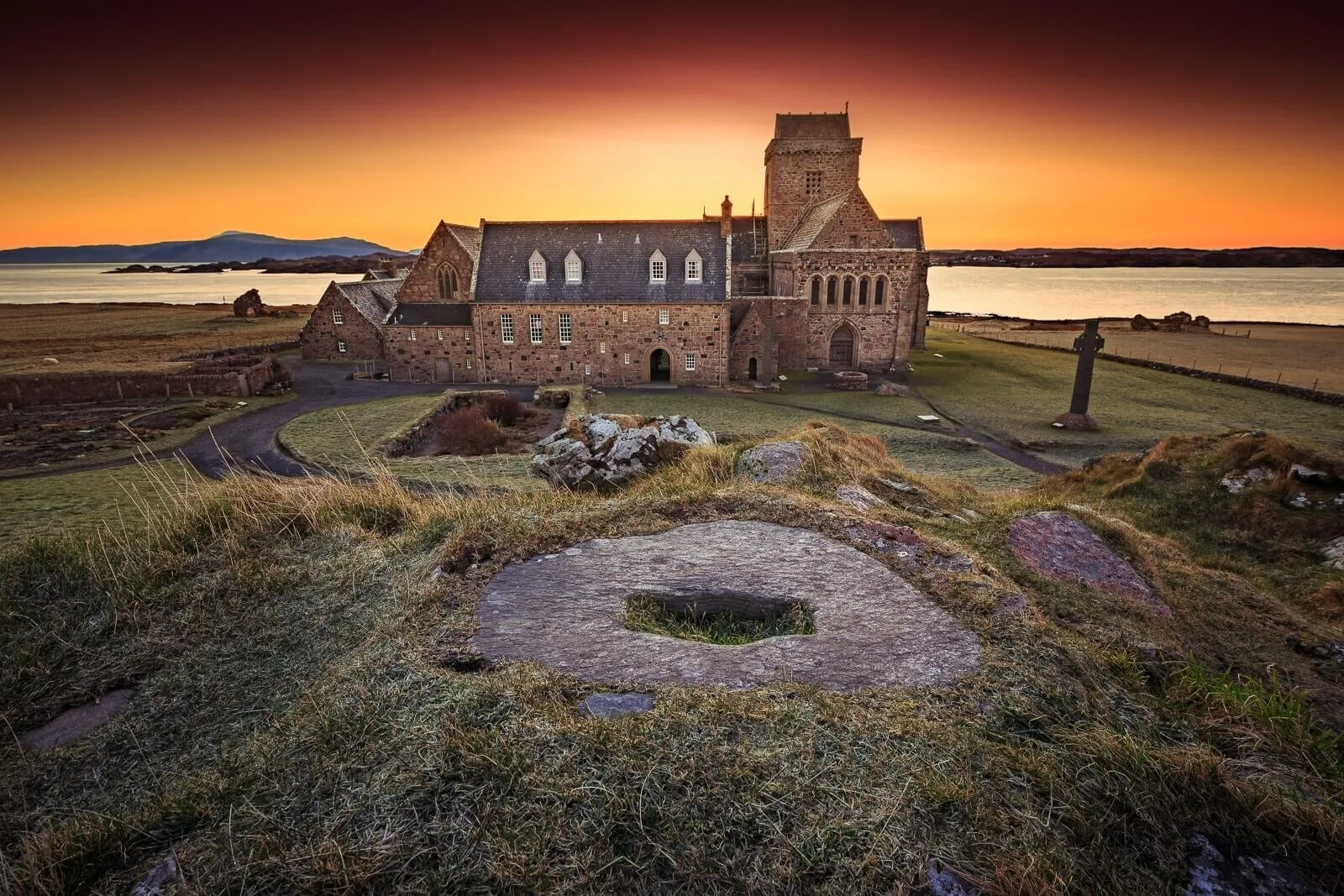
On August 15, 1057, Macbeth was killed at the Battle of Lumphanan in Aberdeenshire. Malcolm sent Macbeth’s body to be buried in the holy isle of Iona, where many other Scottish kings were buried. This was an acknowledgment by Malcolm and the other great houses, that Macbeth was a King. Macbeth was the last King to be buried in Iona. As such, some say he was the last true King of Scotland.
Macbeth was a ruler of great skill and fortitude, and a man willing to give his people peace and prosperity without losing popularity or support. It was said he was tall, blonde and of ruddy complexion earning him the nickname ‘The Red King’. A handsome man by all accounts.
The Duan Albanach (Song of the Scots), is a Middle Gaelic poem with 27 stanzas, dating to the reign of Malcolm III. It calls Macbeth "Mac Bethad the renowned". In The Prophecy of Berchán, a verse history which purports to be a prophecy, describes him as "the generous king of Fortriu".
MacBeth name meaning and origin
The family name Macbeth is derived from the Gaelic name "Mac Beatha," meaning "son of life" or "son of Beatha."
MacBeth Spelling Variations
McBeth
Mcbeth
Macbeth
MacBeathe
MacBeath
McBeath
Mac Bheatha
Beaton
Beetonv
MacBeaton
McBee
Machethad
Machetad
Macbethad